


TL;DRFor slabs, ground floors, precast panels and walls, ribbed welded wire mesh is usually the faster, more uniform choice. For columns, piers and deep footings, rebar cages remain the safer call. Many projects use both. Pick by load, element type and the design code in your contract.
Buyers often ask us the same thing: can welded wire mesh replace rebar? The honest answer is "it depends on the element you are pouring". Both materials hold concrete together once it cracks under tension. They simply suit different jobs.
This guide compares the two for importers, contractors and distributors. The technical details come from the product data of Tianjin Anguyuan Metal Products Co., Ltd., a welded mesh manufacturer based in Beichen District, Tianjin.
|
2007 Year established |
30,000 t Annual welded mesh capacity |
5+ National standards supported |
3 Export regions: Europe, Australia, SE Asia |
01Quick Pick: Where Each Option Wins
|
◆ Choose welded mesh Ground slabs, footpaths, precast panels, walls and residential slabs. |
◆ Choose rebar Columns, piers, deep footings and elements that need bespoke bent shapes. |
◆ Combine both Rebar in edge beams and footings, mesh across the slab area. |
02What Ribbed Welded Reinforcing Mesh Brings to a Slab
|
Anguyuan's concrete steel wire mesh is made of ribbed steel bars joined by spot welding. The ribs improve bonding to the concrete and help limit shrinkage cracking.
|

03Welded Wire Mesh vs Rebar: Head-to-Head
| Factor | Tied rebar | Welded wire mesh | Usually better |
| Site labour | Bars are cut, placed and tied by hand | Prefabricated sheets, laid and lapped | Mesh |
| Spacing consistency | Depends on the crew's tying | Factory-welded, uniform grid | Mesh |
| Crack control in slabs | Wider spacing between bars | Closer, even bar spacing | Mesh |
| Columns, piers, deep footings | Cages bent to the engineer's drawing | Not the usual choice | Rebar |
| Custom shapes | Bent on site or at a bending yard | Cut-and-bent and purpose-made fabric | Depends on the job |
Check the ductility class, not just the priceMesh is not one single grade. Anguyuan lists elongation limits by standard, and they differ:
|

04How to Choose Concrete Reinforcement in 5 Steps
|
1Name the element. Slab, wall, precast panel, footing or column?
2Confirm the code. Use the standard in your drawings, such as BS 4483, AS/NZS 4671 or DIN 488.
3Match the ductility class. Ask your engineer which class is required.
4Set bar size and opening. Light type (3-10 mm) or heavy type (12 mm minimum).
5Plan the supports. Mesh is commonly used with bar chairs so it sits within the slab, not on the ground.
|

05Why Buyers Source Welded Mesh from Anguyuan
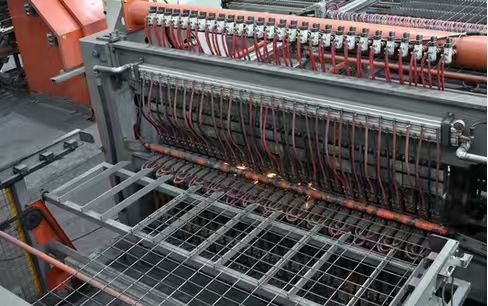
See the production line on our equipment process page. |
06FAQ: Welded Wire Mesh vs Rebar
Hover over a question to read the answer.
07Final Thoughts
The welded wire mesh vs rebar decision is rarely either-or. Use mesh where a uniform grid and fast laying matter, and rebar where the element needs bespoke bent steel. If your drawings call for special sheet sizes, ask about cut and bent fabric or purpose made steel fabric.
Need a quotation or a mesh specification check?
Send your drawing, standard and quantity, and our team will reply with options.
Send Inquiry →Contact Us